Completing patient forms
Patients can complete forms online prior to or during their visits. The patient can open the online portal from his or her appointment reminder by using the button (with email messages) or link (with text messages) provided. You can also open the patient's portal on a practice-owned mobile device.
Notes:
-
The Web address for a patient's online portal is unique to a given patient. Each patient must open the online portal using the link (or button) that is specific to his or her record.
-
The link to the online portal is valid for seven days or until the associated forms have been completed, whichever comes first. After that, you must generate a new link if the patient still has not used the original link provided.
-
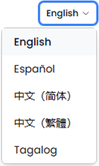
All forms are available in English, Spanish, Chinese (simple), Chinese (traditional), and Tagalog for patients. In the patient forms portal, when a patient opens a form, the browser's language setting is detected, and if it matches one of the supported languages, the form is automatically displayed in that language. However, if the the browser language does not match one of the supported form languages, the form is displayed in the standard default language. As needed, the patient can manually select one of the supported languages, overriding any automatically selected language, by expanding the language menu in the upper-right corner and then selecting the desired language.
To complete a patient form (patient does this)
-
The patient (or the patient's representative) clicks the link in the text message (or button in the email message) he or she receives.
-
The patient does one of the following:
-
If the patient is accessing the patient forms portal from an email message, he or she does the following:
-
The system generates a unique six-digit OTP and sends it to the patient’s email address (if the patient is his/her own primary contact) or the email address of the patient’s primary contact (if someone else is the patient’s primary contact). The patient opens the email message with the verification code (OTP).
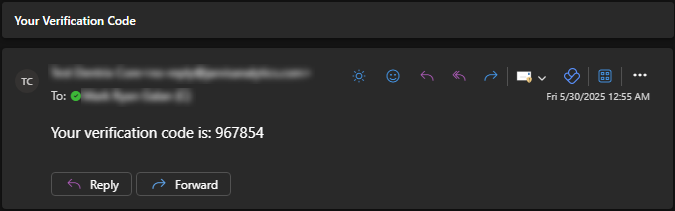
Note: The OTP is valid for two hours.
-
In the patient forms portal, the patient enters the OTP and then clicks (or taps) Verify.
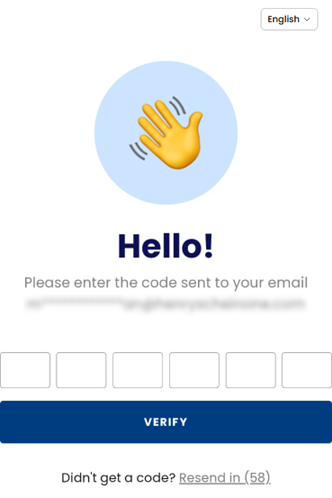
Notes:
-
The patient has three attempts to enter a given OTP correctly.
-
After three failed attempts, or if the OTP has expired, the patient can request a new OTP:
-
The patient can request a new OTP up to three times per form access session (per unique link click leading to an authentication attempt).
-
Requesting a new OTP invalidates any OTP sent previously for that session.
-
Each new OTP is valid for two hours.
-
-
-
-
If the patient is accessing the patient forms portal from a text message, from a direct link in an email message, or on a practice-owned mobile device, he or she does the following:
-
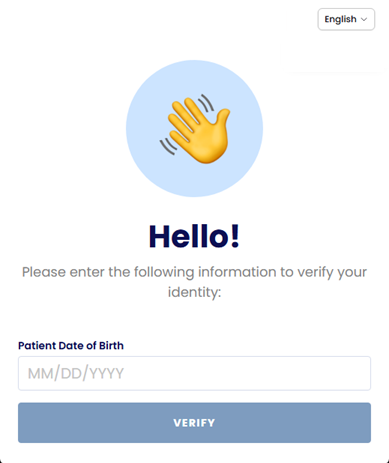
In the patient forms portal, the patient enters his or her birth date and then clicks (or taps) Verify.
-
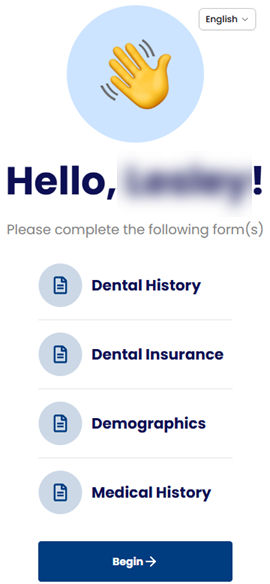
The patient portal lists the forms that are due for that patient.
-
-
The patient clicks (or taps) Begin to start completing the forms.
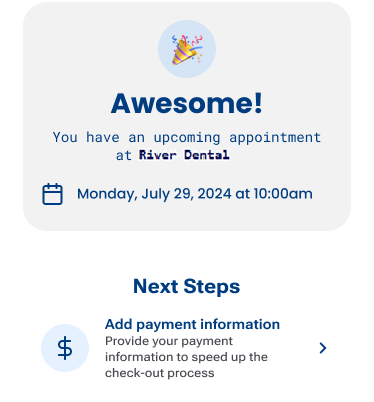
After the patient completes and submits the forms, a completion message appears.
Notes:
-
If the patient has an upcoming appointment, the message may include the location and date and time of that appointment. The appointment reminder appears only in the following scenarios:
-
An automated appointment reminder is sent to the patient with an upcoming appointment. The patient clicks the link to complete online forms and then completes and submits the forms.
-
From the Appointment Information panel of the patient's upcoming appointment, a request to complete online forms is sent to the patient. The patient clicks the link to complete online forms and then completes and submits the forms.
-
-
Depending on the card-on-file setting for patient forms, the message may also include an option to save a card on file with the office.
-
Notes:
-
If a form submission triggers an update of a patient's demographics, applicable entries appear in the Audit Log. The Details column contains "Form Write-back" and what information was written to the database.
-
A patient's record can be updated automatically by responses to a question about allergies, problems, or medications on a submitted form. If a patient selects an allergy, problem, or medication on the form (a "positive" response, such as indicating that he or she is taking Allegra), the patient's record will be updated. If a patient removes a selected allergy, problem, or medication on the form (a "negative" response, such as indicating that he or she no longer takes Advair), the patient's record will be updated. Any of the following may occur when a response to an allergy, problem, or medication question on the form is synchronized with a patient's record:
-
If the allergy, problem, or medication does not exist for the patient (an expired medication is considered not to be an existing medication in the patient's record), and that allergy, problem, or medication on the form has a positive response (the allergy, problem, or medication is active), the following occur:
-
It is added to the patient's list of allergies, problems, or medications
-
For that allergy, problem, or medication in the patient's record, the text "Indicated by patient via forms" and the date are included as a note.
-
For that allergy, problem, or medication in the patient's record, the default status of the following switches are based on the status of those switches for that allergy, problem, or medication in your library: Show alert switch (for an allergy, problem, or medication) and the Critical (for a medication only) or Is permanent switch (for an allergy or problem only).
-
An applicable entry appears in the audit log. The Details column contains information regarding the added allergy, problem, or medication and "indicated by patient via forms."
-
-
If the allergy, problem, or medication does exist for the patient, it is not expired, and that allergy, problem, or medication on the form has a positive response (indicating that the allergy, problem, or medication is active), it remains in the patient's list of allergies, problems, or medications.
-
If the allergy, problem, or medication does exist for the patient, it is not expired, and that allergy, problem, or medication on the form has a negative response (indicating that the allergy, problem, or medication is not active), the following occur:
-
It remains in the patient's list of allergies, problems, or medications but is marked as "Expired."
-
For that allergy, problem, or medication in the patient's record, the text "Expired by patient via forms" and the date are added as a note or appended to any existing note text.
-
An applicable entry appears in the audit log. The Details column states that the allergy, problem, or medication for the patient was expired by the patient via a patient form.
-
-
-
If the patient uploads or takes pictures of an insurance card and/or a driver's license or other type of ID card to fill in insurance and/or personal information for a form, copies of the cards are saved in the patient's Document Manager after the patient submits the completed form. Cards that are saved in the Document Manager have the applicable tags assigned to them automatically:
-
Insurance Card (Front) and Insurance Card (Back) - The tag is "Patient Insurance."
-
Driver's License (Front) and Driver's License (Back) - The tag is "Patient Information."
-
-
If the patient completed the Spanish, Chinese, or Tagalog version of a form, all selections that the patient made (such as those using checkboxes, drop-down lists, and yes/no questions) on the form are translated back into English in the .pdf file that is saved in the patient's Document Manager; however, any free-text responses that the patient typed in Spanish, Chinese, or Tagalog (such as the answer to a question like "What is your primary concern?") on the form remain in that language in the .pdf file.
-
After successful submission of the forms, the email or text link to the portal becomes expired to prevent future authentication attempts.