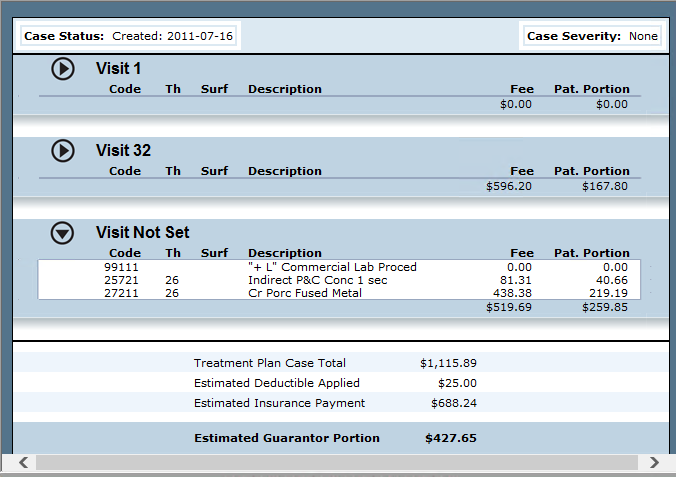
Depending on the view options you selected, you can include insurance estimates in the case detail.
Insurance estimates are calculated using the following process. First, any deductibles to be applied to the treatment plan are calculated. Then, the deductible of the first procedure in the list is subtracted from the cost of the procedure and applied to the patient portion. Finally, any remaining amount is included in the insurance estimate.
After applying the deductible amount, if each remaining procedure on display has an entry in the Payment Table that indicates a specific dollar amount the insurance company will pay for the procedure, that amount is used as the insurance estimate for the procedure. If the Payment Table does not contain a figure, the Insurance Coverage Table is referenced to find the percentage of the fee the insurance company covers and then that percentage is included in the insurance estimate.
Note: When setting up the insurance Coverage Table in the Family File, you can flag certain procedures as requiring pre-authorizations. The Treatment Planner automatically places an “N1” or “N2” (depending on whether the primary or secondary insurance requires pre-authorization) in the PreAuth column when a procedure requiring pre-authorization is part of the treatment plan.
The following example explains the calculation method.
A patient has a $25 deductible to be applied. The patient has procedures totaling $1,115.89 treatment planned. According to the coverage table, both procedures are covered by the insurance at 50%.
To calculate the insurance and patient portions, the deductible amount is first applied to the largest procedure and by subtracting the deductible ($25). The coverage percentage of 50% is applied to this ($461 x 50%), making the estimated insurance portion $684.24. The patient portion for this procedure is the original fee minus the estimated insurance portion.
The next procedure, the root canal, is then figured. No Payment Table entry exists, so the insurance Coverage Table is used to figure the insurance portion for the root canal. The patient would owe the remaining portion.
The two insurance portions are added, and the insurance estimate results in ($688.24). The patient owes the remainder ($427.65).